

Different histories. Different choices. And the unsettling possibility that we are not so different after all.
"I would never do that."
You've probably said those words. Maybe not aloud. Sometimes they arrive so quickly that you barely notice them.
Someone makes a decision you can't understand. A friend returns to a relationship everyone knows is hurting them. A stranger loses their temper over something trivial. Someone defends a belief you find impossible to accept.
And there it is.
I would never do that.
Perhaps you're right.
But something about those five words has always bothered me.
How can we be so certain about a life we've never lived?
The Person You Used to Be

Think about something you did years ago that you wouldn't do today.
Not necessarily anything terrible. Perhaps you trusted someone you shouldn't have. Refused an opportunity because you were afraid. Said something deliberately hurtful, then spent years finding ways to justify it.
You remember the circumstances.
You remember what you believed then, what you feared, what you thought you were protecting.
Maybe you still remember the conversation. Where you were sitting. The expression on someone's face when you said something you couldn't take back.
If you could return to that moment with everything you know today, would you make the same choice?
Probably not.
But here's the difficulty.
The person you were then didn't have the understanding you have now.
They couldn't have known what you would learn afterward.
They made their decision with whatever experience, judgment, fear, and hope they possessed at that particular moment.
And even if you now disagree with that decision, you can understand why you made it.
You were there.
You know the story.
Now imagine someone who witnessed only what you did.
They didn't know what had happened to you the previous week. They didn't know the childhood experiences that shaped your reaction or the disappointment you had never told anyone about.
They saw your decision.
And they judged you.
Perhaps they thought exactly what you've thought about other people.
I would never do that.
Something feels different when you're the person being judged, doesn't it?
The History We Cannot See

We meet people in the middle of their stories.
There's no introduction explaining how they became who they are. No account of the people who influenced them, the opportunities they missed, or the experiences that taught them to expect disappointment.
We encounter a few minutes of their lives and often assume we understand the whole person.
Sometimes a few minutes are enough to know that someone's behavior is unacceptable.
But they are seldom enough to know why that person behaves as they do.
Think about an ordinary disagreement.
Two people hear the same words.
One feels insulted. The other hears nothing offensive.
The difference may have little to do with the words themselves.
One person remembers being humiliated by someone they trusted. The other has never experienced those words in that way.
They are responding to the same conversation through different histories.
Neither can see everything the other is carrying.
Yet each may be perfectly convinced that their interpretation is obvious.
And isn't that familiar?
We've all been certain about something, only to discover later that there was more to the story.
Occasionally, we even learn that the person we judged was struggling with something we knew nothing about.
When that happens, our memory of the encounter changes.
Their words remain the same.
Their behavior remains the same.
What changes is our understanding.
Which presents an uncomfortable possibility.
How many people have we misunderstood without ever discovering it?
The Difference Between You and Me
I sometimes think about human differences in terms of an idea I call 99% PURE.
It's not a scientific measurement of personality or a claim that we can reduce the complexity of humanity to a precise percentage.
It's a way of questioning how much of our apparent separation comes from the different lives we've experienced.
Consider how much we share before we begin explaining ourselves.
We want to feel safe.
We want our lives to matter.
We want somebody to understand us without requiring us to defend every decision we've made.
We dislike being dismissed.
We remember embarrassment more vividly than we'd like.
And when someone tells us we're wrong about something important, our first reaction isn't always curiosity.
Sometimes we defend the belief simply because it belongs to us.
Then there are the countless circumstances that make us different.
The families we were born into. The people we met. The things we were taught. The chances we took and the ones we avoided.
Over time, those differences accumulate.
They become preferences, convictions, habits, fears, and expectations.
Eventually, we begin mistaking the person produced by our particular history for the only person we could ever have become.
But think about that for a moment.
If you had been raised somewhere else, surrounded by different people, taught different lessons, and exposed to different consequences, would you still see the world exactly as you do?
You might retain some of the same inclinations.
You might not.
We cannot know.
And that uncertainty is worth respecting.
Because the person whose opinions seem incomprehensible to you may be responding to their history with the same confidence that you bring to yours.
You don't have to agree with them to recognize that.
The Moment We Almost Miss

There's a small moment in an argument when everything can go in more than one direction.
You know the moment.
Someone says something that irritates you.
You feel yourself preparing a response. You already know what you're going to say. Perhaps you've had versions of this argument many times before.
The familiar words are ready.
Then, occasionally, something interrupts.
A question.
Why did that bother me so much?
Or perhaps:
What does this person know that I don't?
Nothing remarkable has happened outwardly.
The other person may not even realize you've hesitated.
But in that little interval, something important becomes possible.
You can repeat the response you've used before.
Or you can choose differently.
You can ask a question instead of making an accusation.
You can disagree without humiliating someone.
You can recognize that the person standing in front of you knows things about their life that you don't.
This doesn't mean every disagreement can be resolved.
Some differences are serious. Some actions bring harm. Understanding someone's circumstances doesn't erase responsibility for what they do.
But understanding can change how we respond.
And sometimes, that changes what happens next.
I think this is one of the most useful ways to approach the idea of nonlinear perception.
Not as an extraordinary ability to predict events, but as a willingness to notice possibilities our habits ordinarily conceal.
We see more than the response we were preparing to give.
And for a moment, our past doesn't have to dictate our next choice.
The Stranger in Your Own Memory
There's another person worth considering.
Someone you know better than almost anybody.
Someone whose decisions you've questioned, whose mistakes you've revisited, whose behavior occasionally embarrasses you.
The person you used to be.
Imagine meeting that person today without knowing who they were.
Perhaps you'd find them impatient.
Too trusting.
Unreasonably certain about things they hadn't yet experienced.
Maybe they'd express an opinion you no longer hold, or speak casually about something you now consider important.
Would you like them?
Would you understand them?
Or would you be tempted to dismiss them?
It's a strange thought.
You might judge your younger self the same way you judge a stranger.
And yet, once you learned their history, everything would change.
You would know what they were trying to accomplish.
You'd remember what frightened them.
You might wish they'd made better decisions, but you would understand the circumstances surrounding those decisions.
You wouldn't need to agree with the person they were.
You'd recognize them.
Because they were you.
And perhaps this is where understanding other people begins.
Not by pretending we're all identical.
But by remembering how much we've changed without ever becoming someone entirely separate from ourselves.
When Two Histories Meet
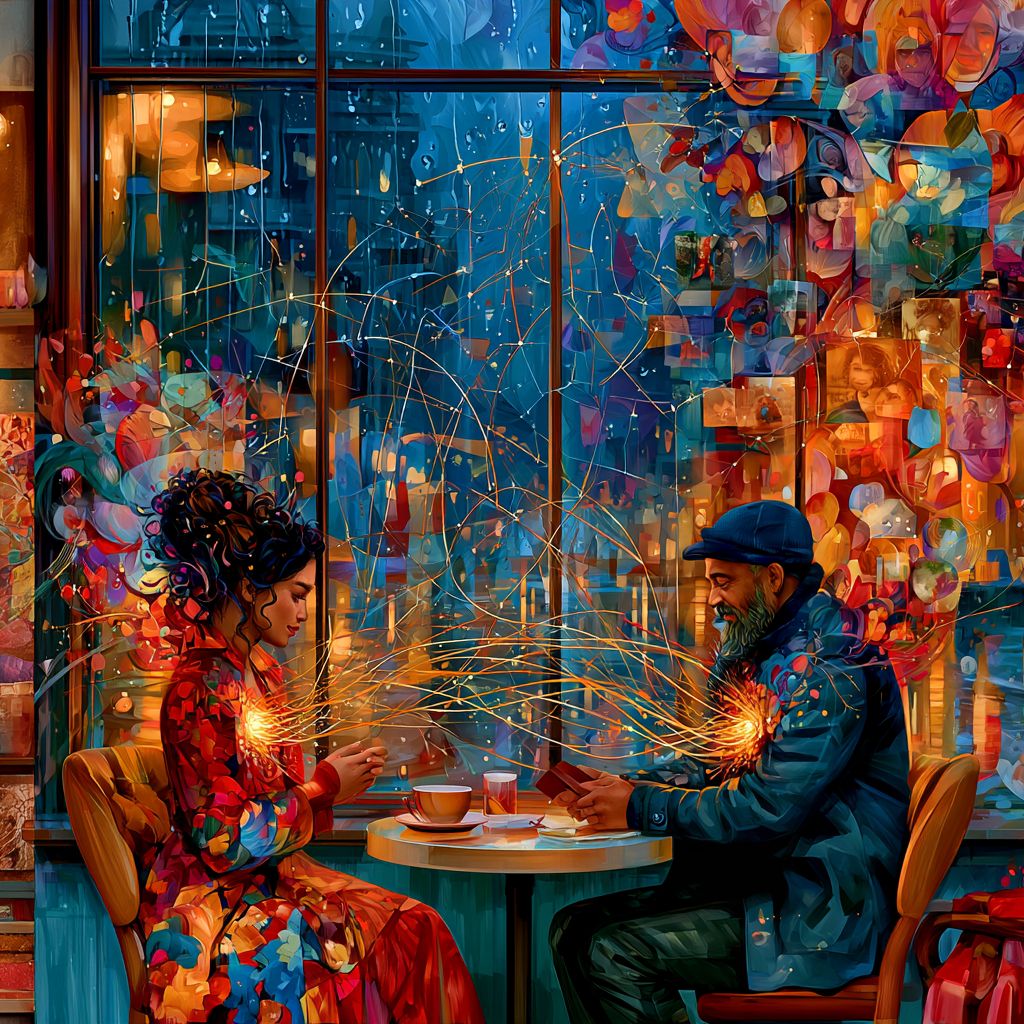
Have you ever met someone and found yourself talking as though you'd known them for years?
It can happen in the most ordinary circumstances.
You're waiting somewhere. Sitting beside someone on a long journey. Talking to a person you've only just been introduced to.
At first, the conversation is unremarkable.
Where are you from?
What do you do?
How do you know the people here?
Then somebody mentions something personal.
Maybe it's the difficulty of watching a parent grow older.
Or the strange guilt of succeeding when someone close to you is struggling.
Or the realization that an important decision was made for reasons you no longer understand.
And suddenly, the conversation changes.
One person begins describing an experience.
The other knows the feeling before the explanation is finished.
You haven't lived the same life.
You may not have much else in common.
Yet something passes between you that needs surprisingly little explanation.
It's not agreement.
It's recognition.
For that moment, neither person needs to convince the other that their experience matters.
Both already know.
Later, you'll leave.
You'll return to different homes, different responsibilities, different problems waiting to be solved.
Years may pass without another encounter.
If you meet again, you'll have changed in ways neither could have predicted.
But perhaps another moment of recognition will occur.
Not because your histories have become identical.
Because underneath their differences, there are experiences you still understand.
We tend to remember such meetings.
Not always the words.
Sometimes only the feeling of having been understood.
The Part of This Story I Couldn't Write